
نموذج قراءة sample reading texts اللغة الإنجليزية الصف الثاني عشر عام الفصل الدراسي الثاني 2025-2026
Guidance on the Sample Reading Text Bank
Teachers are provided with a sample reading text bank to support the development of Term 2 School-based Summative Assessment. For each reading component, two sample texts are included (two texts for Reading Part 1 and two texts for Reading Part 2). The sample texts are illustrative only and are not compulsory assessment materials. Teachers are not required to use these texts and may replace them with alternative texts that meet the same requirements.
Rationale
:The sample reading texts demonstrate
- • Appropriate CEFR level for each reading part
- • Suitable text length and linguistic complexity
- • Alignment with Term 2 curriculum themes and content
- • Consistency with the sample test specifications
They provide a shared reference point for what constitutes an acceptable reading text for assessment purposes.
1. Text Information
Each sample text is accompanied by reference information indicating
- • CEFR level
- • Theme
- • Text type
This information is intended to support accurate text selection and alignment when sourcing or creating alternative texts.
2. Teacher Autonomy in Text Selection
: Teachers may
- • Use one of the sample texts as a model
- • Adapt a sample text to suit their students
- • Select or create an alternative text
: Any alternative text selected should
- • Match the CEFR level specified for the reading part
- • Reflect a theme covered during Term
- 2 • Use the same text type as indicated
- • Be comparable in length and level of challenge to the sample texts
3. :Question Development
Teachers are responsible for
- • Designing questions to accompany the selected text
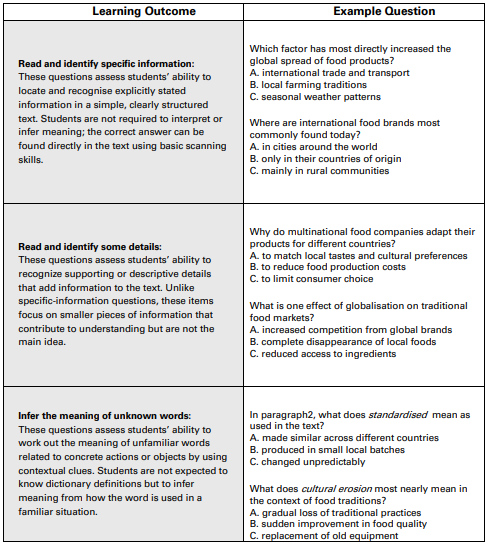
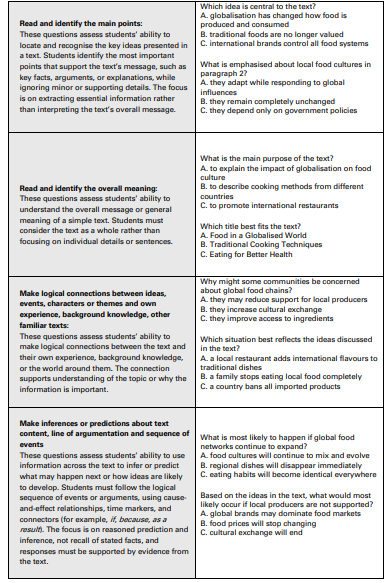
- • Ensuring questions assess the intended skills for each part
- • Keeping all questions within the scope of the Term 2 curriculum
- • Ensuring each question is directly supported by information in the text and cannot be answered without reading
- • Aligning each question to a specified Learning Outcome (LO)
4. Formatting
4.1 Font*
Univers is the typeface for English Language.
Heading Text
- Font: Univers
- Font Size: 16
Topic/Subheading Text
- Font: Univers
- Font Size: 14
Normal Text
- Font: Univers
- 12:Font Size
* For documents accessible to students in Grades
4.2 Page Margins
The *page margins should be set to “Normal
- § Top: 2.54cm
- Bottom: 2.54cm
- Left and Right: 2.54cm
* This will not apply to cover page
Reading 1
Text 1
For many years, it was thought that using Gross Domestic Product (GDP) was a good way to measure a nation's success. GDP shows the total value of goods and services produced in a country. It is a simple way to view economic growth. However, many experts now seriously wonder whether GDP is a true measure of peoples’ well-being. It focuses mainly on money and ignores other important aspects of life. For example, GDP counts spending on pollution or crime prevention as positive for the economy. Whereas these things highlight problems in society. Also, it does not include volunteer work, such as caring for people, or any damage to the environment
To give a more balanced view, new measures have been developed. One is the Human Development Index (HDI), created by the United Nations. The HDI looks at three main things: life expectancy, education, and income per person. Life expectancy measures how long people live, and this indicates the quality of health care. Education includes the number of years at school, and income uses GDP for each person. Therefore, the HDI gives a wider picture of human development than GDP alone
Another important measure is the World Happiness Report, published every year. It uses surveys asking people to rate their own happiness. The report's results show that happiness is complex. It depends on factors like social support, freedom to make choices, generosity, and trust in government. Countries with strong social safety nets and low crime numbers often rank high, even if their GDP is not the highest
Bhutan, a small country in Asia, has its own idea called Gross National Happiness. This version puts well-being at the center of government decisions. It includes culture, environment, and community solidarity
These alternative measures show a trend toward a better understanding of happiness. They suggest that money alone does not make a nation happy. In fact, true human development needs balance in health, education, and social connections